
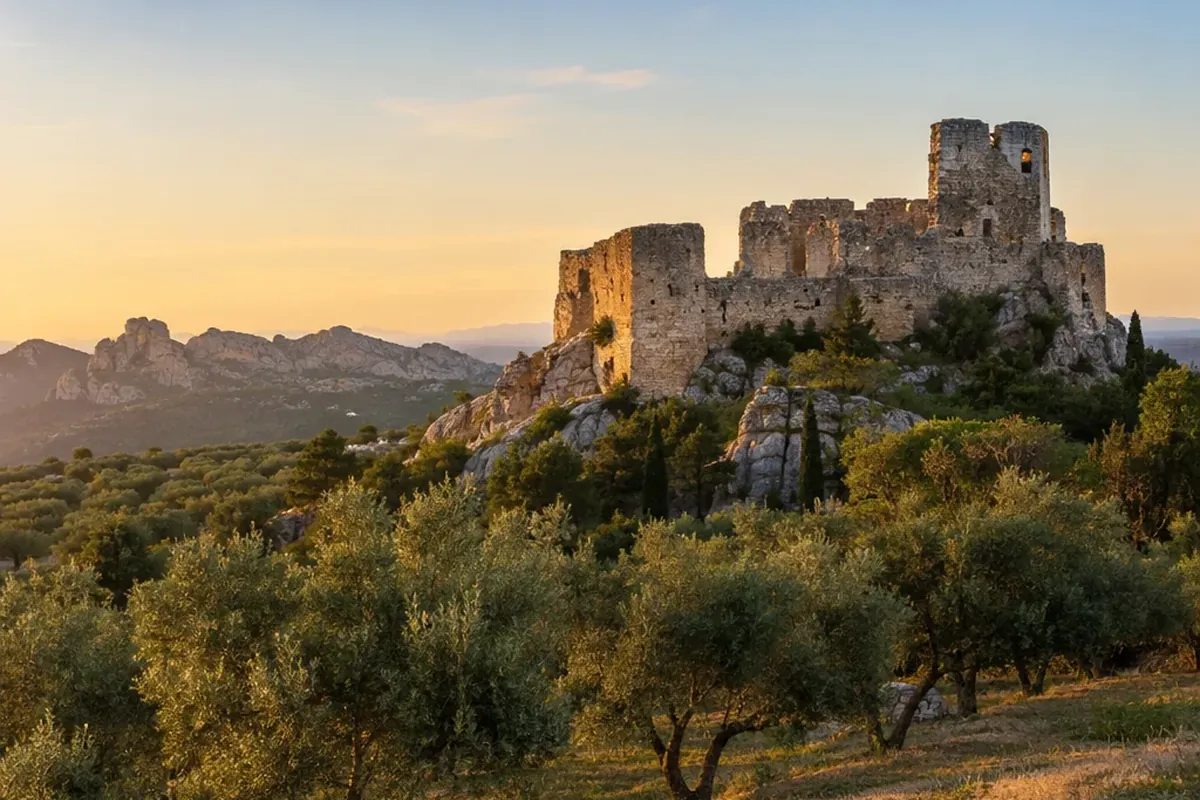
Les Baux-de-Provence is worth visiting for an unusually concentrated Provence experience: a medieval village on a limestone outcrop, the seven-hectare ruins of the Château des Baux, and an art installation inside a former quarry all sit within the Alpilles. Come for a half day at minimum, or give it a full day to combine the castle, Carrières des Lumières, a walk, and a meal beyond the busiest streets.
Why Les Baux-de-Provence belongs on a Provence itinerary
The name comes from the Provençal word bauç, meaning a steep escarpment, cliff, or rocky outcrop. On the plateau in the Alpilles, the village lives up to that name, 22 kilometers south of Avignon and 15 kilometers northeast of Arles. In clear weather, the castle plateau looks south toward the Camargue and east toward Mont Sainte-Victoire.
Since 1998, Les Baux has been part of Les Plus Beaux Villages de France. Its scale makes the contrast striking. In the upper village, about 20 people live permanently, yet the commune receives roughly 1.5 to 2 million visitors a year. For that reason, timing visits helps avoid the peak crowds.
More than a picturesque village, this stop combines several eras. From the 10th-century fortress to a 12th-century church partly carved into rock, the landscape holds its history in plain view; a former limestone quarry now projects moving art across walls and floors. Nearby, Pierre Berthier discovered bauxite, the aluminum ore, in 1821 and named it for the village.
Start at Château des Baux for ruins and long Alpilles views
At the Château des Baux, do not expect a furnished palace. Across seven hectares of rock, a partly troglodytic ruined castle provides the setting. Instead of moving room to room, you walk through the defensive landscape, with the village on one side and open country below.
For about 500 years, the Lords of Baux controlled the castle and village. In the 12th century, their court was known for troubadours and courtly love. After Alix, the last Princess of Les Baux, died in 1426, the stronghold passed to the County of Provence. Following a rebellion, Louis XIII had the fortress dismantled in 1633.
Set aside 1.5 to 2 hours here. Above the valley, the donjon is the most imposing surviving structure; its rock face was cut as much as 20 meters deep to make an ascent harder. Full-scale replicas of medieval siege engines turn the history from an outline into something tangible.
- Look for the 16-meter, seven-ton trebuchet, Europe’s largest working example.
- From April through September, demonstrations of the siege machines take place several times a day.
- Arrive around 9 a.m. for softer light, fewer people, and more time to take in the views before the village grows busy.
Cool off at Carrières des Lumières, where art fills a quarry
At the foot of the village in Val d’Enfer sits Carrières des Lumières, a former limestone quarry worked from 1800 until it closed in 1935. Here, more than 100 video projectors animate over 7,000 square meters of walls and floor, making the setting as important as the images.
Before the present digital art center opened in 2012, Jean Cocteau filmed scenes here in 1959. Later, Albert Plécy created the Cathédrale d’Images projection spectacle in 1977–78. Rather than an add-on to the village, the space is another chapter in how this carved landscape has been used.
For a summer midday break, choose this stop. At 12–14°C regardless of the heat outside, the quarry stays cool, while a visit generally takes 45 to 60 minutes. For adults, a combined Château and Carrières pass is listed at €21, compared with about €27.50 for separate tickets.
Use this half-day or full-day plan to see more than the main street
A quick visit can cover the village, castle, and quarry, but it is easy to spend longer if you want the church, museums, or a walk in the Alpilles. The pedestrian village requires leaving your car in the paid lots at the entrance, so treat the first walk uphill as part of the visit.
| Time available | A practical plan |
|---|---|
| Half day | Allow about one hour for the village, 1.5 hours for the castle, and 45 minutes for Carrières des Lumières. |
| Full day | Begin at the castle around 9 a.m., pause for coffee in the village, visit the quarry around late morning, then have lunch outside the village and add a museum or walk. |
| More time | Walk the easy 6.2-kilometer Val d’Enfer route, which takes about 2.5 hours and passes troglodytic houses and unusual rock formations. |
For a quieter cultural stop, the Musée Yves Brayer occupies the 16th-century Hôtel de Porcelet and displays about 100 paintings, watercolors, and drawings. The free Musée des Santons holds roughly 400 Provençal nativity figures from the 17th through 21st centuries. Saint-Vincent, a 12th-century Romanesque church partly cut into the rock, has modern stained glass by Max Ingrand.
Beat the crowds and use the weather to your advantage
April through June and September through October offer warm conditions with fewer crowds. July and August are the most crowded months, and weekdays are noticeably calmer than weekends. On any busy day, arrive before 10 a.m. or after 4 or 5 p.m. to avoid the heaviest foot traffic and the midday heat.
Les Baux is a place where wind matters. In strong Mistral conditions, the upper castle area can be hazardous, so it is wiser to skip the ascent. The quarry makes a useful alternative on a hot day, while winter brings a notably quieter village. On Christmas Eve, the traditional Pastrage ceremony presents a living nativity.
Eat the flavors of Provence beyond the busiest tables
For the most useful food strategy, separate the village visit from lunch. Restaurants in Les Baux itself are more expensive and more tourist-oriented; Maussane-les-Alpilles and Saint-Rémy-de-Provence, five to ten minutes away by car, offer less expensive and more authentic choices.
The local ingredient to seek out is olive oil from the Vallée des Baux-de-Provence. Its AOP covers olive oil, cracked green olives, and blackened olives. Producers use a blend of five olive varieties, including Aglandau, and the olives must be pressed within three days of harvest to qualify for the designation. The area’s two recognized flavor profiles are green-fruity and mature black-fruity.
More broadly, the foods most associated with Provence include ratatouille, aioli with vegetables, tapenade, bouillabaisse, pissaladière, and slow-cooked beef daube. The local wine appellation produces red, rosé, and white wine; it covers 277 hectares and 12 estates, and all its land has been farmed organically or biodynamically since the 2023 vintage.
Turn Les Baux into an easy Alpilles base for nearby stops
Les Baux sits in the heart of the triangle formed by Arles, Avignon, and Salon-de-Provence, south of the Alpilles ridge. That makes it easy to pair with Saint-Rémy-de-Provence, 10 kilometers north, where Van Gogh and the ruins of Glanum are key draws, or with Arles for its Roman arena and Van Gogh connection.
A car gives the most flexibility. From Avignon, the drive via the A7 and D570N/D27 takes about 35 to 45 minutes for 35 kilometers; from Marseille, allow about 1 hour 15 minutes for 90 kilometers. The nearest TGV stations are Tarascon at 15 kilometers, Arles at 20, and Avignon TGV at 30. Bus 707 links Avignon, Saint-Rémy, Les Baux, and Arles in about an hour from Avignon.
Provence can be costly, especially in summer: accommodations run 30–40% higher in July and August than in April–May or September–October. Visiting in the shoulder season, using the bus where it fits, and having lunch outside Les Baux are concrete ways to make this stop less expensive.
Three common misconceptions about Les Baux
“It is only a photogenic village.”
The streets are beautiful, but the real scale is at the castle and in Val d’Enfer. Add the quarry and the site becomes a combination of medieval defenses, geology, and immersive art rather than a short photo stop.
“The castle is too ruined to be interesting.”
The ruins are the experience. The seven-hectare site preserves a dramatic defensive setting, a formidable donjon, and working reconstructions of a trebuchet, ballista, couillard, and bricole.
“Summer heat makes the whole visit unpleasant.”
Heat changes the order, not necessarily the plan. Start at the castle early, then move into the 12–14°C quarry around midday. Strong Mistral wind, rather than heat alone, is the condition that can make the upper castle unsuitable.
Frequently Asked Questions
What is Les Baux-de-Provence known for?
It is known for its medieval village on an Alpilles outcrop, the Château des Baux ruins and siege machines, panoramic views, and the Carrières des Lumières digital art center in a former quarry.
What are the best things to do in Les Baux-de-Provence?
Prioritize the château, Carrières des Lumières, and a walk through the pedestrian village. With more time, add Saint-Vincent, the Yves Brayer or Santons museum, or the 6.2-kilometer Val d’Enfer walk.
How much time should you spend in Les Baux-de-Provence?
Plan at least half a day for the village, castle, and quarry. A full day works better if you want lunch, a museum, or a walk in the Alpilles.
How do you get to Les Baux-de-Provence?
It is about a 35–45 minute drive from Avignon and 1 hour 15 minutes from Marseille. Bus 707 connects Avignon, Saint-Rémy, Les Baux, and Arles; the nearest TGV stations are Tarascon, Arles, and Avignon TGV.
Where should you eat and stay when visiting Les Baux?
For meals, Maussane-les-Alpilles and Saint-Rémy-de-Provence offer less expensive and more authentic dining than restaurants in the village itself. For lodging, accommodation rates in the region run 30–40% higher in July and August than in the shoulder seasons.
Is Provence expensive to visit?
Costs vary widely by travel style, but summer is the most expensive period: accommodations run 30–40% higher in July and August than in the shoulder seasons (April–May and September–October). Visiting in spring or fall can reduce both crowds and costs.