
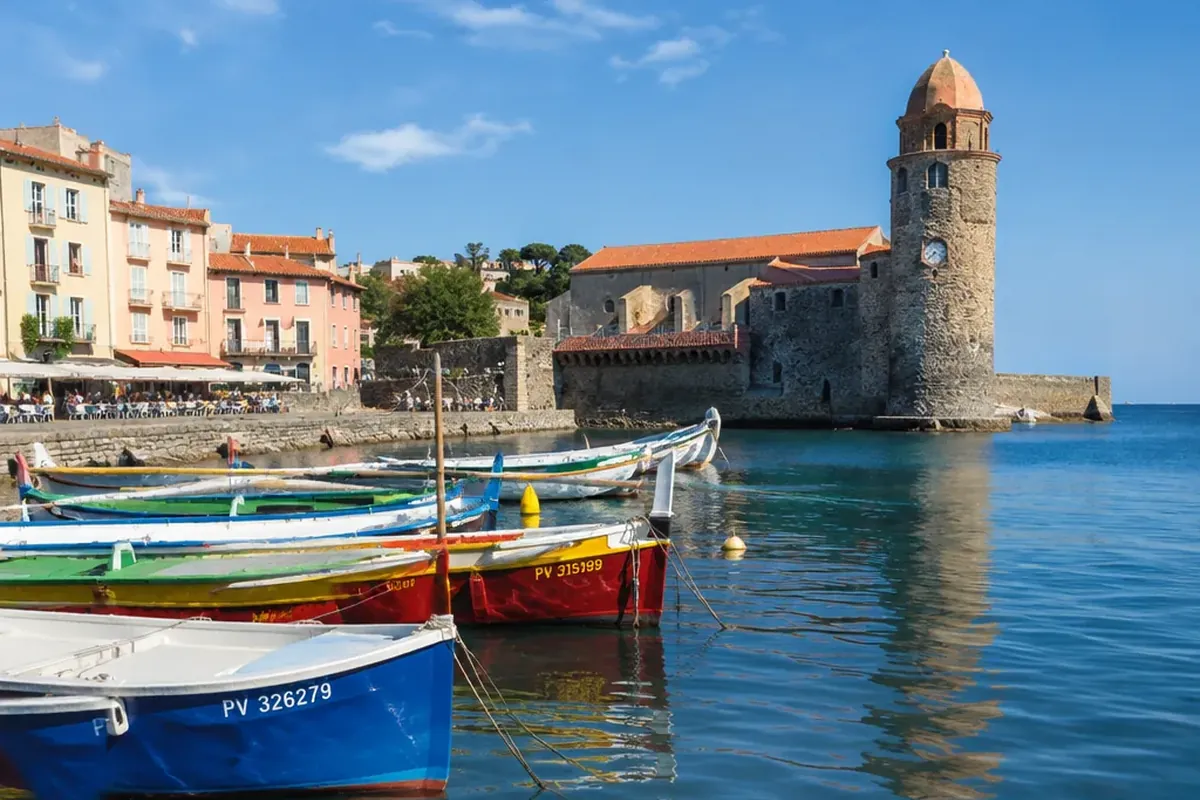
Collioure, France pairs a working fishing tradition with a royal fortress on the water and the harbor that helped launch Fauvism. In 15 to 20 minutes, you can walk across its old town from the castle walls to the pink-domed church, following the waterfront that Henri Matisse and André Derain painted in 1905.
Why Collioure, France feels unlike the rest of the coast
Collioure sits on the Côte Vermeille in Occitanie, about 30 kilometers south of Perpignan and less than 7 kilometers from the Spanish border, where the Pyrenees meet the Mediterranean Sea. The name Côte Vermeille, or “purple coast,” comes from sunlight catching the slate and giving the shore red and ocher reflections.
Its bay served as a natural sheltered harbor in antiquity. Port-Vendres lies to the south and Argelès-sur-Mer to the north, but Collioure maintains a distinct Catalan character.
The town displays yellow-and-red Catalan flags, bilingual French and Catalan street signs, and shop names using el or las rather than French articles. French is spoken alongside Catalan, which is experiencing a revival after a period when it had faded from daily use.
See the harbor through the eyes of the Fauves
Matisse and Derain spent about nine intense weeks in Collioure in the summer of 1905. Derain arrived between July 3 and 5 and stayed until August 31. Working with pure, bright color straight from the tube rather than naturalistic color, they painted the harbor, beach, boats, and castle.
That summer produced 45 paintings in total, alongside drawings, watercolors, and sketches: Derain returned with about 30 paintings, while Matisse brought back 15. When their Collioure works appeared at the Salon d’Automne in Paris that fall, critic Louis Vauxcelles coined the term les Fauves (“the wild beasts”), giving Fauvism its name.
Follow the Chemin du Fauvisme, not just the view
The Fauvism trail (Chemin du Fauvisme) along the waterfront places reproductions of works by Matisse and André Derain at the locations where they were painted.
Derain’s Le Faubourg de Collioure shows Voramar beach with the Château Royal behind it. The original is housed in Paris at the Centre Pompidou.
Start your walk at the castle, then let the waterfront lead
The Château Royal de Collioure stands with its foundations in the Mediterranean, on a site with Roman predecessors, and was recorded in 673 as Castrum Caucoliberi. From 1276 to 1344, the kings of Majorca used it as a summer residence and enlarged it.
French forces captured Collioure in 1642, and the Treaty of the Pyrenees made it permanently French in 1659. In the 17th century, Vauban added the outer defensive wall and removed the medieval quarter inside the fortifications to create an open glacis, now used as a parking area. In 1939, the castle became a prison, first for Spanish Republican exiles and later for French Resistance fighters.
Admission starts at €9 per adult. Inside are the immersive “Explora” experience and a permanent exhibition on the exile of Spanish Republicans.
- Begin at the Château Royal.
- Walk around Boramar beach and along the waterfront on the Fauvism trail.
- Continue to Notre-Dame-des-Anges by the water.
- Choose a beach stop or follow the coastal path toward the southern coves.
Choose the beach that matches your day
Collioure has five principal beaches, with varying shorelines:
| Beach | What to expect |
|---|---|
| Boramar | 150 meters of fine pebbles, close to the center. |
| Saint-Vincent | 150 meters of sand and pebbles behind the church. |
| Faubourg / Port d’Avall | The only all-sand beach; especially popular with families. |
| Balette | An 80-meter, quieter beach south of the harbor. |
| Crique de l’Oli | A wild cove reached by walking along the coast. |
For swimming, June through September is the primary season; water temperatures rise from about 14°C in spring to 24°C in August. Boramar, Faubourg, and Saint-Vincent are supervised from May 29 to September 21 in the 2026 season, with lifeguards on duty from 10:30 a.m. to 6:30 p.m. in July and August.
The rocky coves of Roches Bleues, Batteries, and Oli are reached via the Sentier du Littoral. The walk takes roughly 15 to 30 minutes on foot, and sturdy footwear is recommended.
Eat the anchovy that made this a fishing village
Fish was already being preserved in salt in Collioure during the Middle Ages. In 1865, the town counted 140 Catalan fishing boats and 800 fishermen; by the middle of the 20th century, 21 salting works employed 350 people.
Two family businesses continue this tradition: Anchois Roque, founded in 1870 and now in its fifth generation, and Anchois Desclaux, founded in 1903 and now in its fourth. The fish is now generally imported from Morocco or Argentina because local catches no longer meet demand, but the salt curing remains in Collioure. The anchovies mature for three to 12 months, and Anchois de Collioure has held protected geographical status (IGP) since 2004.
Plan the season, journey, and length of stay
May to June and September to October offer mild weather with daytime temperatures typically between 22 and 28°C. July and August bring daytime highs around 31°C (occasionally reaching 35–40°C), fuller beaches, and peak rates. Around August 15, the Saint-Vincent festival brings music and fireworks and draws twice as many visitors as the town has residents.
Winter brings daytime temperatures of 11–12°C, fewer visitors, and rare snowfall. October is the wettest month, averaging eight rainy days and 85 mm of precipitation.
How to get to Collioure without making the arrival the hard part
The train station is a few minutes’ walk from the center. Hourly TER trains connect Perpignan and Collioure in about 20 minutes for €5–10. From Paris, the TGV reaches Perpignan in about 4.5 hours. Bus line 540 from Perpignan takes about 55 minutes and costs €2–10.
Drivers approach via the A9 toward Spain, then follow the RN114 coast road from Perpignan-Sud or Le Boulou. During the May–September season, drivers can use the free Cap Dourats park-and-ride lot and its free shuttle into town. The nearest airport is Perpignan-Rivesaltes, 36 kilometers away.
Two full days are recommended for the town: the old town, beaches, and castle on the first day; the Fauvism trail and coastal walking on the second. Four to five days allow time to explore the wider Côte Vermeille, Port-Vendres, Banyuls, local vineyards, and the border area.
Know the two big misunderstandings before you go
Myth: Collioure is only a summer beach town
The town’s best-known landmark, the bell tower of Notre-Dame-des-Anges, originated as a medieval lighthouse, while the castle reflects the history of Majorca’s kings, French border defense, and Spanish Republican exiles. Shoulder season provides temperatures of 22–28°C for touring historical sites and following the walking trails.
Myth: Fort Saint-Elme is a standard stop on every itinerary
The five-pointed star fortress above town was built between 1538 and 1552 under Charles V and later strengthened by Vauban. It offers a 360-degree view over the bay, the Roussillon plain, and the Pyrenees, but it has been closed to visitors since 2023 while undergoing renovations by its private owner.
Frequently Asked Questions
How do you pronounce Collioure in French?
Collioure is pronounced “kol-YOOR” [kɔljuʁ], with the stress on the last syllable and a silent final “e.” In Catalan, the name is Cotlliure.
Did Matisse live in Collioure?
No. Matisse spent about nine weeks in Collioure in the summer of 1905 with Derain and returned to the Côte Vermeille in later years. Derain never returned after 1905.
What language do they speak in Collioure?
French is the primary language, and Catalan is also spoken. The town features bilingual street signs and Catalan flags.
What are the best things to do in Collioure?
Key sights include the Château Royal, the Chemin du Fauvisme trail, Notre-Dame-des-Anges, the town beaches, and the Sentier du Littoral coastal path toward Port-Vendres.
When is the best time to visit Collioure?
May to June and September to October offer temperatures of 22–28°C and moderate crowds. Summer brings the warmest water, along with fuller beaches and higher prices.
How many days do you need to visit Collioure?
Two full days cover Collioure itself. Plan four to five days to include the surrounding Côte Vermeille, Banyuls, Port-Vendres, vineyards, and the border area.