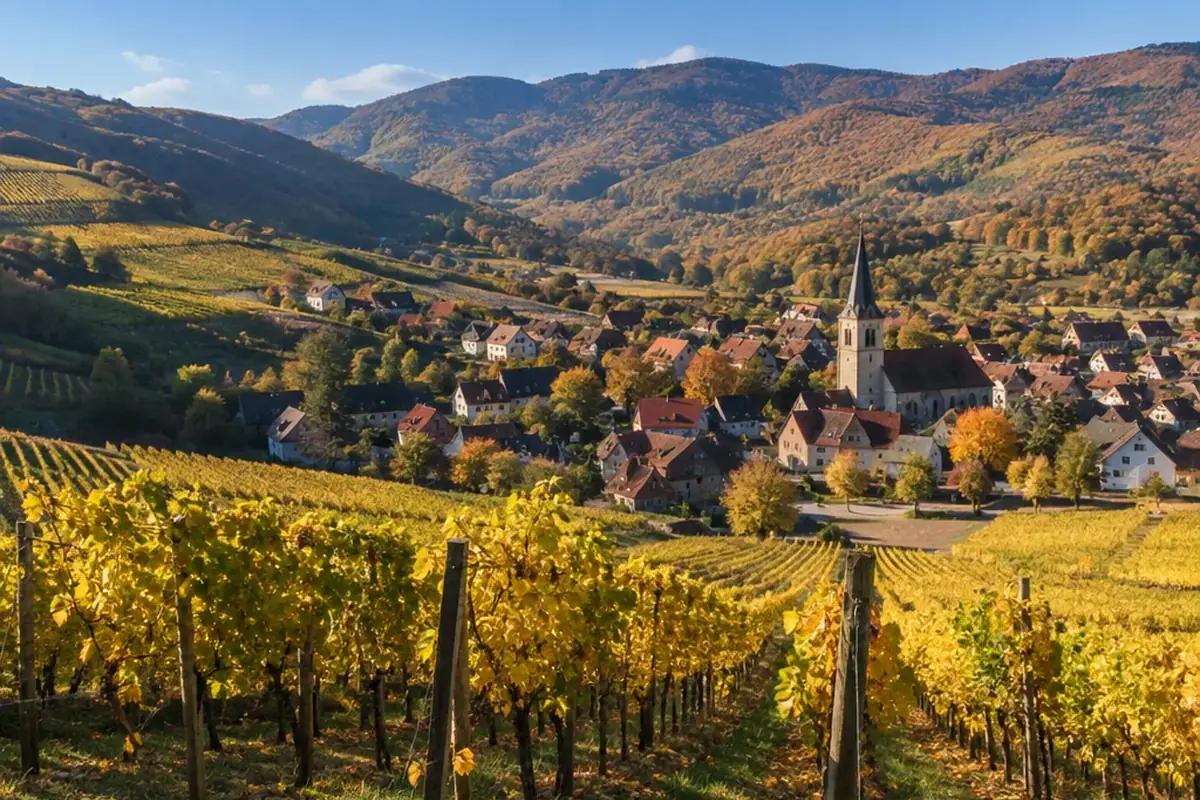
Alsace, France is the narrow strip of vineyards, half-timbered villages and castle-topped hills between the Vosges Mountains and the Rhine. It is best known for a 170-km (106-mile) wine route, Strasbourg’s Gothic cathedral, Colmar’s wine culture and some of Europe’s best-known Christmas markets. It belonged to Germany twice between 1871 and 1945, so the region feels part French and part German. That shows in the village names, the dialect and the food. Strasbourg is only 1 hour 45 minutes from Paris by high-speed train, so you can reach Alsace without a long transfer.
Where Is Alsace, France?
Alsace sits in the far northeast of France, within the Grand Est administrative region. It lies on the west bank of the upper Rhine, where France borders both Germany and Switzerland. Its natural borders are the Vosges Mountains to the west and the Rhine River to the east. At 8,280 km² (3,200 sq mi), it is roughly the size of Puerto Rico.
The region has two departments: Bas-Rhin (67) in the north and Haut-Rhin (68) in the south. About 1.9 million people live here. Strasbourg is the largest city, with 294,229 residents, and the economic and cultural capital. It sits right on the German border. Colmar lies 64 km south of Strasbourg and calls itself the capital of Alsatian wine.
The Vosges block rain coming from the west. As a result, Colmar gets just 595 mm (23.4 in) of rain a year, which makes it one of the driest cities in France. This dry, sunny climate is ideal for growing grapes.
How far is Alsace from Paris?
By road, Alsace is about 430 km (267 mi) from Paris. In a straight line, the distance is roughly 396 km (246 mi). The TGV from Paris-Gare-de-l’Est reaches Strasbourg in 1 hour 45 minutes, with several departures a day.
What the Alsace Region Is Known For: A French Region with German Roots
The name comes from Old High German Ali-saz or Elisaz, meaning “foreign domain.” It fits a region that changed hands repeatedly:
- Alsace was part of the Holy Roman Empire until France annexed it in the 17th century, after the Thirty Years’ War.
- After the Franco-Prussian War in 1871, it became part of the new German Empire, within the territory of Alsace-Lorraine.
- France got it back after World War I in 1919. Nazi Germany re-annexed it in 1940, and it returned to France in 1944–45.
That history is visible everywhere. You can see it in the half-timbered houses, in village names like Riquewihr, Hunawihr and Mittelbergheim, and in Kaysersberg, which means “Emperor’s Mountain.” Ribeauvillé is called Ràppschwihr in Alsatian. The traditional language, Alsatian, is an Alemannic dialect closely related to Swabian German.
Other things Alsace is known for:
- Strasbourg Cathedral: This Gothic cathedral was completed in 1439 and stayed the world’s tallest building until the 19th century.
- European institutions: Strasbourg is home to the European Parliament and the Council of Europe.
- Beer: Alsace is France’s main beer-producing region, with major breweries in and around Strasbourg.
- Christmas markets: Strasbourg calls itself the “Capital of Christmas,” and its markets run from late November to late December.
How do you pronounce Alsace?
In American and British English, it is “al-SASS” (/ælˈsæs/), rhyming with “class.” In French, it is [alˈzas], with a soft “z” sound and a silent final “e.”
Driving the Alsace Wine Route
The Route des Vins d’Alsace opened in 1953 and is France’s oldest designated wine trail. It runs 170 km from Marlenheim in the north to Thann in the south, along the eastern foothills of the Vosges. The route passes through more than 70 wine-growing communes and borders 51 classified Grand Cru vineyards. It draws more than 2.5 million visitors a year.
Alsace labels its wine differently from the rest of France. It is the only major French wine region that makes almost entirely single-variety wines, and the label names the grape. So you order a Riesling or a Pinot Gris, not a place name you need to decode. Seven grapes make up the region’s wines:
| Grape | What to expect |
|---|---|
| Riesling | Called the king of Alsatian wines. Usually dry, mineral and good for aging. |
| Gewurztraminer | The most aromatic grape, with notes of rose, lychee and spice. Pairs with Munster cheese and desserts. |
| Pinot Gris | One of the seven classic Alsace grapes. |
| Muscat | One of the seven classic Alsace grapes. |
| Pinot Blanc | One of the seven classic Alsace grapes. |
| Sylvaner | One of the seven classic Alsace grapes. |
| Pinot Noir | The only red grape among the seven. |
Look for two rare wines at tastings: Klevener de Heiligenstein and Rouge d’Ottrott. Both are grown almost nowhere else. For sparkling wine, ask for Crémant d’Alsace, which is made by the traditional méthode champenoise.
You can drive the full route in 2–3 relaxed days. The northern section passes through Obernai, Barr, Andlau and Molsheim. The southern half, around Colmar, has the best-known wine villages.
The Best Towns, Villages and Castles to Visit in Alsace
Many of the top places to visit in Alsace are within a short drive of Colmar. That makes Colmar the easiest base for exploring villages, while Strasbourg is better for city sightseeing.
| Place | Population | Location | Don’t miss |
|---|---|---|---|
| Strasbourg | 294,229 | On the German border | The Gothic cathedral (1439), the old town and the Christmas markets |
| Colmar | 67,360 | 64 km south of Strasbourg | The self-styled capital of Alsatian wine and a Christmas market town |
| Eguisheim | 1,729 | 7 km from Colmar | Streets laid out in circles around the Château des Comtes |
| Riquewihr | About 1,200 | 11 km from Colmar | Intact medieval walls and a castle museum |
| Ribeauvillé | 4,685 | 16 km north of Colmar, 75 km south of Strasbourg | Three Grand Cru vineyards and a medieval musicians’ festival |
| Kaysersberg | 2,720 | Weiss river valley | A fortified bridge from 1501 and Albert Schweitzer’s birthplace |
Riquewihr: the medieval village that survived
Riquewihr was one of the few Alsatian towns that escaped serious damage in World War II. As a result, its 16th-century townscape is still intact. Its half-timbered houses date from the 15th to 18th centuries, and the original fortifications still surround the town. The castle above it is now a museum.
Eguisheim: a village built in circles
Eguisheim’s streets form rings around the Château des Comtes, so a walk through town takes you in a loop. The village is listed among Les Plus Beaux Villages de France. In 2013, it was voted the French people’s favorite village (“Village préféré des Français”). It sits at the edge of the Ballons des Vosges Nature Park.
Kaysersberg: castle ruins and a Grand Cru
Kaysersberg’s ruined castle stands above the town, and a fortified bridge from 1501 crosses the Weiss river. Albert Schweitzer was born here, and a museum is dedicated to him. The Grand Cru Schlossberg vineyard, whose name means “mountain of the castle,” grows on the slopes nearby.
Ribeauvillé: music and a giant sequoia
On the first weekend of September, Ribeauvillé hosts the Fête des Ménétriers (Pfifferdaj), a medieval musicians’ festival. The town has three of Alsace’s 51 Grands Crus. Its forest also holds the largest giant sequoia outside the United States.
Hidden gems: Hunawihr and Mittelbergheim
For quieter streets, add Hunawihr or Mittelbergheim. Both fit easily into a longer trip and are good alternatives to the busiest villages on summer weekends.
Haut-Koenigsbourg: a castle restored by the Kaiser
Château du Haut-Koenigsbourg stands at 757 m on a rocky spur near Sélestat, above the Upper Rhine Plain. It was first built in the 12th century and abandoned after the Thirty Years’ War. Germany’s Kaiser Wilhelm II had it rebuilt from 1900 to 1908. Where records were missing, architect Bodo Ebhardt filled in the gaps himself, and the keep ended up about 14 m taller than the original. More than 500,000 people visit each year. On clear days, the views reach Germany’s Black Forest. There is even a full-size copy of the castle in Berjaya Hills, Malaysia, next to a replica of Colmar.
What to Eat and Drink in Alsace
Alsatian food blends French and German influences. Order these at least once:
- Choucroute garnie: Finely shredded cabbage fermented with juniper, served with pork, Strasbourg sausages, bacon and potatoes. The French word choucroute comes from Alsatian sûrkrût, meaning “sour cabbage.”
- Flammekueche (tarte flambée): Paper-thin dough topped with crème fraîche, fromage blanc, bacon and onions. It is often called Alsatian pizza.
- Baeckeoffe: Pork, lamb and beef baked for hours in a sealed terrine with potatoes, vegetables and Alsace white wine.
- Munster: A strong-smelling, soft washed-rind cheese from the Vosges valleys, traditionally served with Gewurztraminer.
- Foie gras: Alsace has made it since the 17th century and is one of France’s main foie gras regions.
- Kougelhopf: A sweet yeasted brioche cake baked in a fluted ring mold, often with raisins and almonds.
- Bredala and mannele: Bredala are Christmas cookies, and mannele are brioche figures shaped like little men. Both are baked around the holidays.
To drink, have a glass of local Riesling or Crémant d’Alsace with your meal, or a beer from France’s main brewing region.
When to Visit Alsace
| Season | What to expect | Best for |
|---|---|---|
| Mid-September to late October | Harvest season, 15–22°C (54–72°F), golden vineyards and all wineries open | The wine route and tastings |
| May–June | Mild weather, green vineyards, flowers in the villages and smaller crowds than summer | Walking, cycling and photography |
| July–August | The busiest and hottest season, often over 30°C (86°F). Riquewihr and Eguisheim get very crowded on weekends. | The Colmar Wine Fair (late July to early August), the region’s largest wine event |
| November | The quietest month until late November. Some wineries close for winter winemaking. | Few crowds |
| Late November to late December | Christmas markets in Strasbourg, Colmar and Kaysersberg | The holiday atmosphere. Book lodging up to a year in advance. |
Getting Around Alsace, Plus a 3- and 5-Day Itinerary
The region is compact. You can drive the full north–south length on the A35 motorway in under 2 hours. A car is the most flexible way to reach the wine villages. In peak season, though, parking can be hard to find in Riquewihr, Eguisheim and Kaysersberg, so arrive early.
Without a car, use Alsace’s 14 rail lines and 161 TER (regional express) stations. Trains link Strasbourg, Colmar, Mulhouse and Basel. Bikes ride free on TER trains, except between Strasbourg and Basel at rush hour. That makes it easy to combine train rides with e-bike stretches along the wine route. Each summer, a shuttle runs from valley towns up to the Route des Crêtes, the scenic road along the Vosges ridge.
- Day 1, Strasbourg: The cathedral and the old town.
- Day 2, wine villages: Riquewihr, Ribeauvillé and Kaysersberg.
- Day 3, Colmar and Eguisheim: Spend the morning in Colmar and the afternoon tasting wine in Eguisheim, 7 km away.
- Day 4, Haut-Koenigsbourg: Visit the castle, then explore quieter Hunawihr or Mittelbergheim.
- Day 5, Route des Crêtes: Drive the Vosges ridge for wide views over the region.
Common Myths About Alsace
- “Alsace is basically Germany.” It was German from 1871 to 1919 and again from 1940 until 1944–45. It has been French since then and is part of the Grand Est region.
- “Everyone there speaks German.” French is the main language. About 43% of adults still speak Alsatian, a dialect close to Swabian German rather than standard German, and far fewer young people do.
- “Alsace-Lorraine is the region’s name.” Alsace-Lorraine was a territory of the German Empire. Today, Alsace is its own cultural region and territorial collectivity.
- “Alsace wine is all sweet.” Riesling, the region’s top grape, is usually dry and mineral. Gewurztraminer is the aromatic one.
- “Haut-Koenigsbourg is untouched medieval stonework.” The castle was rebuilt from 1900 to 1908, and the keep is about 14 m taller than the original.
- “Summer is the best time to go.” Summer is the hottest and most crowded season. Mid-September to late October is the ideal window for the wine route, and May–June has smaller crowds.
Frequently Asked Questions
Where is Alsace in France?
Alsace is in northeastern France, in the Grand Est region. It runs along the Rhine, between the Vosges Mountains and the borders with Germany and Switzerland.
Do people in Alsace still speak German?
French is the main language. About 43% of adults speak Alsatian, a Germanic dialect, but the share falls sharply among younger people.
How far is Alsace from Paris?
Alsace is about 430 km (267 mi) from Paris by road. The TGV gets you from Paris-Gare-de-l’Est to Strasbourg in 1 hour 45 minutes.
What is the best base for visiting the wine villages?
Colmar is the best base. Eguisheim is 7 km away, Riquewihr 11 km and Ribeauvillé 16 km, and Colmar has TER rail links to Strasbourg and Mulhouse.
When is the best time to visit Alsace?
Go from mid-September to late October for the harvest and wine tastings. For Christmas markets, go from late November to late December and book lodging well ahead.