
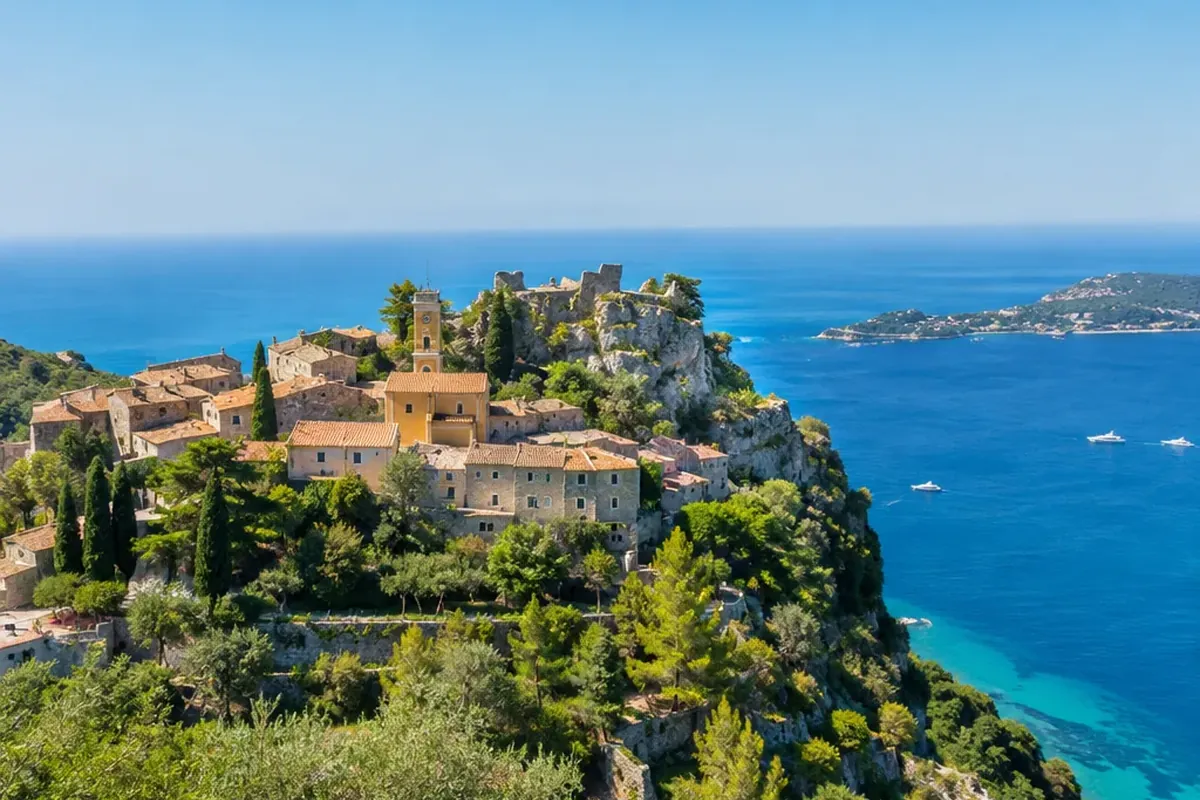
Èze, France, is worth visiting for one very specific reason: a medieval village rises 427 meters (1,401 feet) above the Mediterranean between Nice and Monaco, then ends in a garden built on the site of a fortress. Come for the view, but allow time to get lost in the lanes, climb carefully over polished cobblestones, and understand why this small place is called the Eagle’s Nest.
Why Èze earns a place on a French Riviera itinerary
Between Nice and Monaco, Èze sits 8.5 kilometers northeast of the former and 4.5 kilometers west of the latter. From its rock spur above the sea comes the name Nid d’Aigle, or Eagle’s Nest. Across the commune, elevations run from sea level to 700 meters, but the historic village is the dramatic part: a compact hilltop settlement with medieval stone buildings, pastel shutters, and decorative lanterns.
In 2023, Èze had 2,144 residents, known as Ezasques. For first-time visitors, its two main districts are easy to confuse: Èze-sur-Mer is down at sea level beside the train station, while Èze Village is 427 meters above it.
Read the village through the remains of its past
Around 200 BC, Celto-Ligurians first settled the area on Mont Bastide. Centuries later, the House of Savoy took control in 1388 and strengthened Èze as a fortress because of its proximity to Nice. In 1543, the corsair Hayreddin Barbarossa captured the village for the Ottoman-French alliance. During the War of the Spanish Succession, Louis XIV ordered the castle and town walls destroyed in 1706.
Today, what visitors see is a village shaped by that defensive history rather than an intact castle. Through La Poterne, a 14th-century gate, follow the tight medieval streets upward. Built in 1764, Notre Dame de l’Assomption contains an Egyptian cross associated with Phoenician roots.
Less visible in the story is water. With no natural spring, Èze once relied on water carried in buckets from a nearby outlet. In 1930, composer Samuel Barlow financed the first drinking fountain in the village center; only in 1952 did the public water network arrive.
The best things to do in Èze, from lanes to the garden summit
From La Poterne, wander uphill through the cobblestone streets without trying to tick off each turn. Underfoot, the route is steep, and centuries of traffic have made parts of the stone slick. For a more comfortable exploration, wear flat shoes with a grippy sole.
Reach the Jardin Exotique for the wide-angle view
At 429 meters above the Mediterranean, the Jardin Exotique d’Èze occupies the site of the medieval fortress. Along its south-facing side grow succulents and xerophytes from every continent. On the north side, caves, a waterfall, and Mediterranean and subtropical plants create a cooler contrast. Beneath subtropical planting, a newer Zen area adds a cascade, misting feature, and benches.
On a clear day, the garden’s panorama reaches toward the Esterel Mountains and the Gulf of Saint-Tropez. From 9 a.m., the garden is open; closing time varies by season, from 4:30 p.m. in the winter months to 7:30 p.m. in July, August, and September. From April 1 through October 31, admission is 10 euros, with free admission for children under 12. Dogs on leashes are allowed.
See how perfume is made at Fragonard
The Fragonard perfumery and cosmetics laboratory in Èze Village, in place since 1968, offers free daily tours. During the visit, see eighth-century distillation stills, a soap workshop, and cosmetics production. From 9 a.m. to 6:30 p.m., except December 25, it is open.
Use a simple half-day plan
- Arrive in Èze Village and enter through La Poterne.
- Walk the medieval lanes slowly, saving your legs for the final climb.
- Visit the Jardin Exotique while the light is clear enough for the coastal view.
- Add the Fragonard tour if perfume-making interests you.
Allow three to four hours for the village and garden. Add one to two hours for the Fragonard tour. Before arriving, download tickets and transport details: mobile signal around the upper village square, near the garden entrance, is limited.
Hike the Nietzsche Path only if you want the climb
Over 2.1 kilometers and 350 meters of elevation gain, the Nietzsche Path links the Èze-sur-Mer station with Èze Village. During stays on the Côte d’Azur from 1883, Friedrich Nietzsche walked the route and composed the third part of Thus Spoke Zarathustra here.
Allow about an hour from the coast upward. Expect a moderate hike on earth and gravel without continuous signposting. Look for the start roughly 150 to 200 meters east of the Èze-sur-Mer station, marked “Chem. Frédéric Nietzsche.” Wear sturdy shoes. For the descent from the village, allow for shorter distance but equally uneven ground.
Choose it for the satisfaction of reaching the village under your own power; otherwise, take the shuttle up from Èze-sur-Mer.
Get to Èze from Nice or Monaco without ending up at the wrong level
| Starting point and route | What to expect |
|---|---|
| Nice by bus | Bus #602 toward Monaco Casino or #82 toward Plateau de la Justice leaves from Vauban bus station. The ride takes about 30 minutes. Buses run roughly hourly; only #82 runs on Sundays and holidays, with a much reduced schedule. |
| Monaco by bus | Bus #602 continues from Èze Village to Monaco in about 20 minutes. |
| Nice or Monaco by train | TER trains stop at Èze-sur-Mer: about 10 minutes from Nice and 9 minutes from Monaco, with trains every 15 minutes. From there, hike the Nietzsche Path or reserve the A vos Eze shuttle, about 10 euros each way. |
| By car | Use the Moyenne Corniche (D6007), but expect limited parking. The bus offers coastal views without having to manage the winding road. |
Do not take bus #600 (Monaco) expecting to arrive in the village. Expect it to stop only at Èze-sur-Mer by the sea. For the village itself, use #602 or #82, or plan the train-and-shuttle or train-and-hike combination. Budget 1.70 euros for a bus ticket with a rechargeable card, also valid for a tram transfer within 74 minutes; buying from the driver costs 4 euros.
Choose the season and pace that suit Èze
For the most comfortable visit, choose spring from April through June or fall from September through October: both bring pleasant conditions and fewer people than high summer. Despite more than 300 sunny days a year on the Côte d’Azur, the Mistral can make sunny days in April or October feel cold.
In July and August, expect the longest garden hours and the most visitors. In November, expect quieter, cooler conditions and some restaurant closures.
Where to stay and eat when the village is small
Expect only a few hotels in Èze. For a five-star stay, Château de la Chèvre d’Or has 43 rooms and suites; its restaurant has two Michelin stars. In 1953, Robert Wolf bought the property and opened a restaurant, then added hotel rooms after Walt Disney encouraged him in 1956. Consider Château Eza as the other five-star option.
For a less expensive base, stay in Nice, Villefranche-sur-Mer, or Beaulieu-sur-Mer and visit Èze as a day trip. Bono owns a 20-room villa below Château de la Chèvre d’Or, while The Edge and Julian Lennon also have villas in Èze. The hotel’s guests have included Lauren Bacall and Elizabeth Taylor as well as Barack and Michelle Obama.
Skip these common Èze misunderstandings
- “Èze” is pronounced “ee-zee.” In French, it is one syllable: “ehz.” The final z is not pronounced. In Occitan it is Esa; in Italian, Eza.
- The train arrives in the village. It arrives at Èze-sur-Mer, at sea level. The hilltop village is a separate ascent.
- The garden is just a quick photo stop. It lies 429 meters above the Mediterranean, has distinct south- and north-facing environments, and it rewards time beyond the panorama.
- The old castle is still there. The castle and town walls were destroyed in 1706; the Jardin Exotique stands on the site of the medieval fortress.
Frequently Asked Questions
Is Èze in France worth visiting?
Choose Èze especially if you want a compact medieval village with a high Mediterranean view. Allow three to four hours for the lanes and Jardin Exotique, plus time for Fragonard or the Nietzsche Path.
What is Èze France famous for?
Look for the Eagle’s Nest position above the coast, medieval lanes, the Jardin Exotique at the former fortress site, and Fragonard’s perfume laboratory.
How do you pronounce Èze, the French town?
Say “ehz,” in one syllable. The final z is silent in the French pronunciation.
How do you get to Èze from Nice or Monaco?
From Nice, take bus #602 or #82 to the village in about 30 minutes, or take the TER to Èze-sur-Mer and then hike or reserve a shuttle. From Monaco, the TER reaches Èze-sur-Mer in about 9 minutes, while #602 takes about 20 minutes to Èze Village.
What is the Nietzsche Path?
Follow this moderate 2.1-kilometer trail between Èze-sur-Mer and Èze Village for 350 meters of ascent. Allow about an hour uphill on unpaved, uneven terrain.
What famous people live in Èze?
Among the owners are Bono, The Edge, and Julian Lennon, each with a villa in Èze. Count Friedrich Nietzsche among the artists drawn here; he walked the path now named for him.