
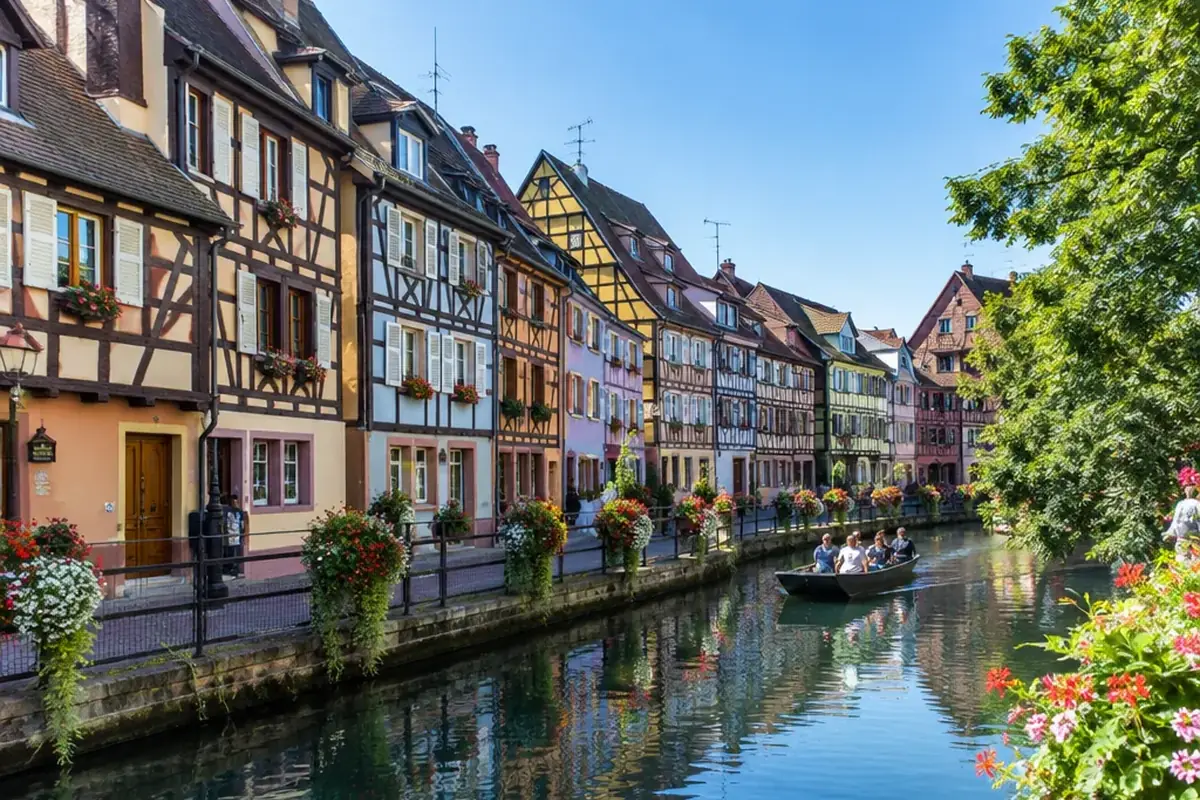
Colmar, France, is special because a remarkably intact Alsatian town meets the Lauch River in a compact, walkable setting. In one day, you can move from pastel half-timbered houses in Little Venice to a 16th-century masterpiece at the Unterlinden Museum, then finish with an Alsatian meal and wine.
What makes Colmar feel different from other Alsatian cities?
With about 67,000 residents in 2022, Colmar is the third-largest municipality in Alsace after Strasbourg and Mulhouse, yet its historic core feels much smaller. On the Lauch, 64 kilometers south-southwest of Strasbourg, it sits directly on the Alsace Wine Route.
First documented in the ninth century, Colmar became a Free Imperial City in 1226 and joined the ten-city Décapole in 1354. In the 17th century, France annexed it, but location and language left a German influence. Largely spared destruction during the Revolution and the wars of 1870–71, 1914–18, and 1939–45, the old town remains a dense record of medieval, Renaissance, and later architecture.
Things to do in Colmar, France: start with water, houses, and art
Follow the Lauch through Little Venice
La Petite Venise is the essential first walk. Along the Lauch, pastel half-timbered houses stand beside canals that once carried goods for fishermen, tanners, and merchants. At Quai de la Poissonnerie, colorful façades reflect in the water; the view is Colmar’s most photographed for good reason.
For a low, water-level perspective, take a barque from Saint-Pierre Bridge. Through the canal, a guide poles the flat wooden boat on a ride of about 25 to 30 minutes. For adults, tickets cost €10; for children ages four to 10, they cost €5. A local legend, rather than a confirmed system, says blue façades marked fishermen and red ones marked butchers.
Read the town in its façades
The old town’s half-timbered buildings span the 14th through 18th centuries, often in the pink and yellow colors of Vosges sandstone. Maison Adolph, around 1350 on Place de la Cathédrale, is considered Colmar’s oldest surviving residence. Maison Pfister, built in 1537 for hatmaker Ludwig Scherer, brings together an octagonal stair tower, wooden gallery, and painted murals.
At Maison des Têtes, completed in 1609, 111 sculpted heads and masks cover the Renaissance façade. Finished in 1480, the Koïfhus is the city’s oldest public building. On its ground floor, imported goods were weighed and stored while the city council met above.
Make room for the Unterlinden Museum
In a former 13th-century Dominican convent, expanded with the former 1906 municipal baths, the Unterlinden Museum presents its defining work: the Isenheim Altarpiece. Made between 1512 and 1516 by Matthias Grünewald and Niclaus of Hagenau for the Antonite convent at Isenheim, it was intended for a hospital caring for sufferers of ergot poisoning. In its intense scenes, patients were meant to find comfort. The museum also holds Martin Schongauer’s Madonna in the Rose Garden.
Build a Colmar day that does not feel rushed
- Begin in the old town. See Maison Adolph, Maison Pfister, Maison des Têtes, and the Koïfhus while the streets are easiest to navigate.
- Walk toward Petite Venise. Pause at Quai de la Poissonnerie, then decide whether the short boat ride is worth adding.
- Give the Unterlinden Museum its own block of time. The Isenheim Altarpiece is not a quick decorative stop; it changes the scale of a visit.
- End at Marché Couvert. The 1865 neo-Baroque covered market is a useful place to seek Munster cheese, Kougelhopf, fresh pretzels, and Alsatian wine.
Art lovers can add the Musée Bartholdi in the Rue des Marchands birthplace of Frédéric Auguste Bartholdi, creator of the Statue of Liberty. Since 1922, it has displayed his drawings, plaster models, and sculptures. At Colmar’s northern entrance, a 12-meter resin replica of the Statue of Liberty also stands.
Colmar or Strasbourg: choose the scale that suits your trip
For a larger city break, Strasbourg is the stronger choice: it has more museums, the European Parliament, and a broader cultural range. For a concentrated old town, a shorter walking day, and direct access to the wine route, choose Colmar.
| Choose | Best for | Useful detail |
|---|---|---|
| Colmar | A compact historic center, river views, and Alsatian wine | One day can cover the old town in roughly four to eight hours. |
| Strasbourg | A larger cultural program and bigger Christmas markets | The TER journey to Colmar takes about 30 minutes. |
| Both | A short Alsace itinerary | Use Strasbourg as a two- or three-day base and take Colmar as a day trip. |
During the holiday season, Strasbourg has the bigger and better-known Christmas markets; in Colmar, the lanes feel more intimate and photogenic.
When to visit Colmar and how long to stay
For warm-weather walking, the most comfortable period runs from mid-June through mid-September, when typical highs are around 24–26°C. Colmar’s sunny microclimate brings only about 530–595 millimeters of rain a year, making it one of France’s driest cities.
In July, high season brings the International Music Festival Colmar and the annual Alsace Wine Fair, held since 1947. From late November through late December, a different peak fills the historic center with six Christmas markets. In 2026, the markets run November 23 through December 29; the Gourmet Market on Montagne Verte continues until January 3. On market days, vehicles cannot enter the old town.
Plan one day for Colmar itself. Two days are the sweet spot if you want the city plus the wine route. Spend three to five days only if Colmar will be your base for exploring more of Alsace.
Eat, drink, and use Colmar as an Alsace wine base
Start with Flammekueche, a thin flatbread with bacon, onions, and crème fraîche. As a meat-and-potato stew, Baeckeoffe offers a different kind of meal; choucroute garnie pairs sauerkraut with pork and potatoes.
Considered the capital of Alsatian wine, Colmar sits on the 170-kilometer Alsace Wine Route, which runs through 70 wine villages. Along it, look for Riesling, Gewurztraminer, Pinot Gris, Pinot Blanc, and Crémant d’Alsace. For a second day, the route provides an easy reason to stay: Eguisheim is 7 kilometers away, while Riquewihr and Kaysersberg can be reached by bus or guided tour in about 20 to 30 minutes. Together, medieval gates and walls, vineyards, and half-timbered lanes offer a distinct companion to Colmar.
Get to Colmar, get around easily, and choose where to stay
From Paris Gare de l’Est, the TGV INOUI takes an average of 2 hours 43 minutes to Colmar over roughly 379 kilometers. On the Paris–Colmar route, about 20 trains run daily, including direct services. From Strasbourg, the TER takes about 30 minutes, with around 37 trains a day.
At 52 kilometers away, EuroAirport Basel-Mulhouse-Freiburg is the closer international airport; Strasbourg Airport is 68 kilometers away. After arrival, Gare de Colmar is a 10- to 15-minute walk from Petite Venise. For a short visit, the central old town and the Petite Venise area are the most practical places to stay: arrive by train and explore the core on foot.
Common Colmar myths that can distort a visit
“Colmar is only a fairytale photo stop.”
Beyond the undeniably picturesque riverfront, the town contains the Isenheim Altarpiece, a work shaped by the real suffering of hospital patients, and a mercantile building where imported goods once passed through the city’s hands.
“Little Venice is a miniature version of Venice.”
Rather than a second Italian city, the name describes a small canal-side quarter. Its value lies in the Lauch, the working history of its waterways, and the close-up scale of the houses.
“Christmas is the only worthwhile season.”
Although Christmas markets are a major draw, summer combines warm conditions with the music festival and wine fair. Beyond the holiday period, the dry local climate also makes Colmar attractive.
Frequently Asked Questions
Is Colmar worth visiting?
Yes, especially if you want a compact Alsatian old town, Little Venice, major Renaissance and medieval buildings, and the Unterlinden Museum in a single walkable stop.
What is special about Colmar, France?
Its old town survived major periods of conflict largely intact, leaving a dense collection of half-timbered buildings alongside the Lauch; it is also home to the Isenheim Altarpiece.
How many days should you spend in Colmar?
Allow one day for the city itself, two for Colmar plus nearby wine villages, or three to five days when using it as an Alsace base.
How do you get to and around Colmar?
Take the train from Paris or Strasbourg, then walk from Gare de Colmar to Petite Venise in 10 to 15 minutes. The historic core is suited to exploring on foot.
What day trips can you take from Colmar?
Eguisheim is 7 kilometers away. Riquewihr and Kaysersberg are reachable by bus or guided tour in about 20 to 30 minutes and make natural wine-route companions.